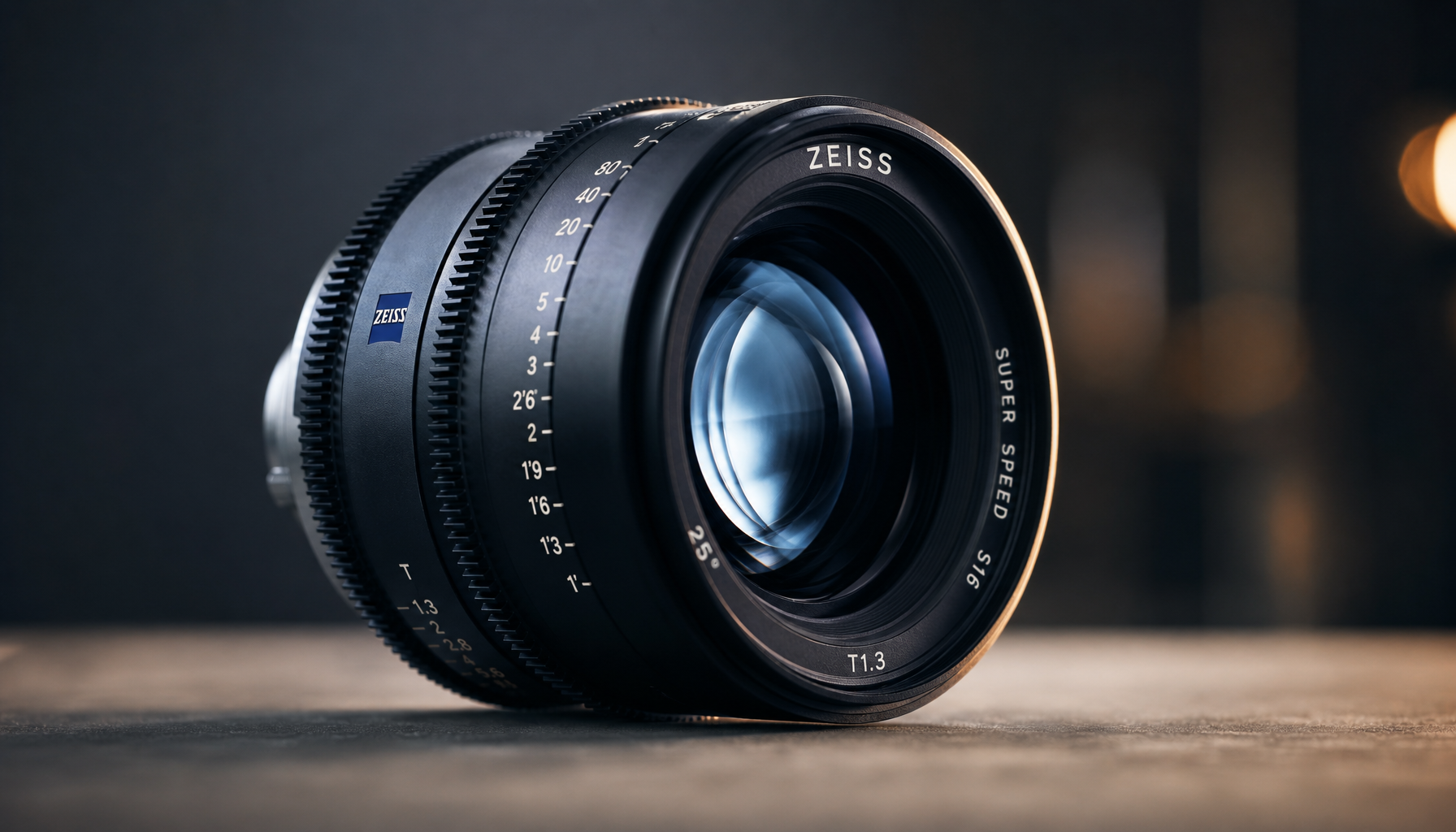
High-speed prime set from ZEISS for Super 16, T1.3 throughout, in 9.5, 12, 16, 25 and 50 mm. Not to be confused with the identically named 35 mm Super Speeds — different design, different image circle, different use.
The ZEISS Super Speed S16 are a set of spherical prime lenses for the Super 16 format with a constant aperture of T1.3. The set includes five focal lengths: 9.5, 12, 16, 25, and 50 mm. They are predominantly available commercially in PL mount; older units feature the ARRI bayonet mount.
The Name Confusion Error
The most common mistake regarding this set is not technical, but an ordering error. "Super Speed" refers to two different lens families at ZEISS: the 35mm set, manufactured from 1975 onwards with focal lengths around 18, 25, 35, 50, and 85 mm, and this S16 set. Both are T1.3, both are called Super Speed, and both are listed under the same name by rental houses. Anyone ordering without specifying the format is highly likely to receive the wrong set. Therefore, the format specification belongs in the inquiry, not in the follow-up question.
Generations
The set exists in several generations, commercially referred to as MkII and MkIII or "2nd Gen." The practically relevant difference lies not in the optics: the gearing and iris are the same. What differs is the focus throw — approximately 180 degrees for the MkII versus approximately 330 degrees for the MkIII.
This means nothing for image sharpness, but everything for the focus puller's work. A long focus throw allows for finer graduations and more precise marks, but costs time for large focus shifts. A short throw is fast and coarse. Receiving a set of mixed generations means working with two different focus feels in alternation — and this is where the set should be checked before shooting, not on the shooting day.
What the Set Doesn't Offer at the Wide End
The shortest focal length is 9.5 mm. On Super 16, this corresponds to a moderate wide-angle — and no more. Anyone wanting to shoot wider than this leaves the family and turns to third-party optics. The fact that this combination occurs in practice has a consequence that counts during preparation: lenses in this extreme wide-angle class are often marked with a photographic f-stop and not a calibrated T-stop. There will then be an exposure difference between T1.3 and an f-stop marking, which must be compensated for on set. A mixed set is not homogenous in terms of exposure, even if the numbers look similar.
Classification
The set is the obvious universal lens choice for Super 16 shoots in low light: available light interiors, night exteriors, music videos, and short corporate films. As a zoom supplement, short S16 zooms are regularly found in the same rental inventories, enclosing the focal length range of the set with reserve and covering shots where lens changes are no longer time-efficient.
Related terms
Quiz
1. Was beschreibt „ZEISS Super Speed S16" am besten?
2. Zu welchem Department gehört „ZEISS Super Speed S16"?