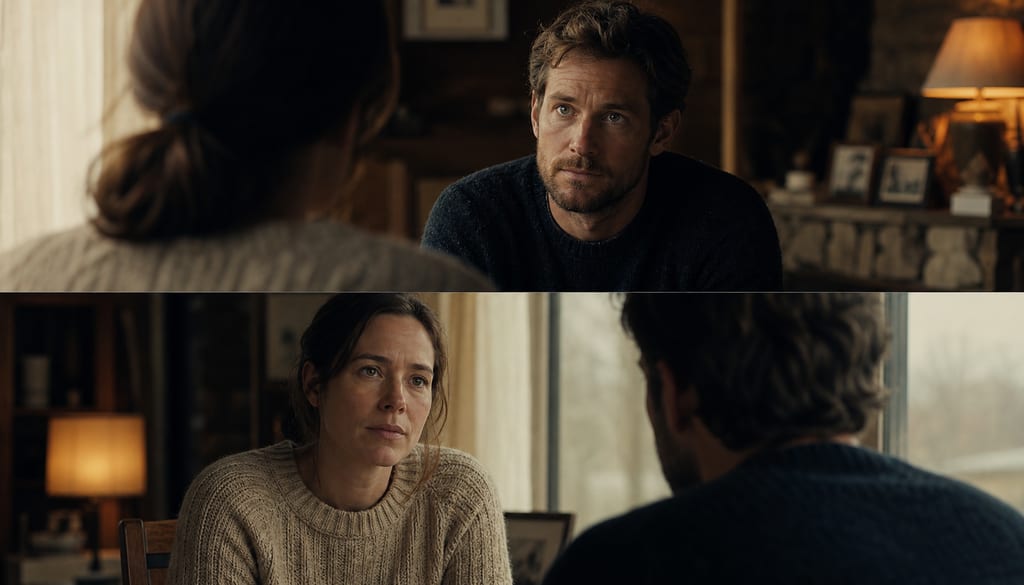
Editing pattern that alternates between two over-the-shoulder shots — the canonical rhythm for filmed dialogue scenes.
Definition
Shot reverse shot (German: Schuss-Gegenschuss) is an editing pattern that alternates between two over-the-shoulder shots to structure a dialogue scene between two characters. The term does NOT refer to a single shot (that would be the OTS shot), but rather to the editing rhythm of at least two OTS frames.
Mechanics
Classic shot reverse shot setup: Camera A films Character 1 over the shoulder of Character 2; Camera B films Character 2 over the shoulder of Character 1. In the edit, the editor alternates between both axes along with the speaker changes. The 180-degree rule ensures the viewer's spatial orientation.
Historical Development
Established from the late 1910s in Hollywood continuity editing. It was adopted by D.W. Griffith and subsequent studio editors as the dominant dialogue convention. Later canonized by classics such as Casablanca (1942), Twelve Angry Men (1957), and virtually every Hollywood dialogue film since.
Variations
- Strict Shot Reverse Shot: Symmetrical frame size + axis mirroring (standard).
- Asymmetrical Pattern: One character in a tighter shot, the other in a wider shot — dramaturgical emphasis.
- Single-Side Coverage: Only one OTS axis + reaction shots of the other character (budget variant).
- Long Take Alternative: Forgoing shot reverse shot in favor of two-shots or a wandering camera (e.g., Tarkovsky, Cuarón) — a deliberate stylistic choice.
Practical Notes
With shot reverse shot coverage, the continuity supervisor must especially track eyelines and hand positions — jumps between takes become immediately visible in the alternating edit. Sound mismatches (breathing patterns, background ambience) also become more apparent than in a long take.
See Also
Related terms
Quiz
1. Zu welchem Department gehört „Schuss-Gegenschuss"?