Filmlexikon.
Support
Negative Film
Camera · Technique

Negative Film

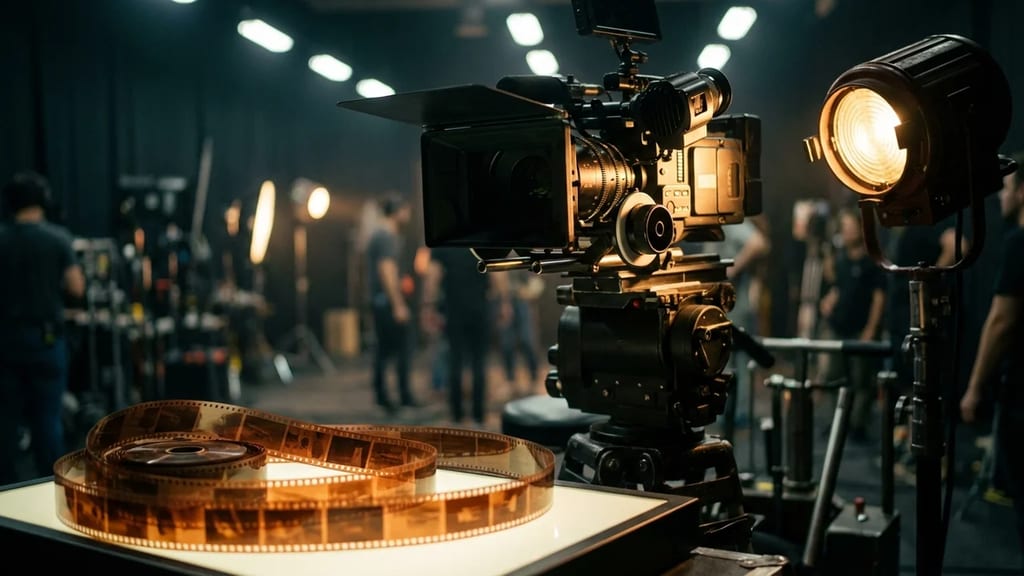
Murnau AI illustration
film stock print film reversal film step printer shuttle printer

Negative film is the standard recording medium for cinematography where subject tones are reversed (bright areas record dark). Color negative films are the dominant motion picture acquisition format, offering excellent latitude and color grading flexibility.

Negative Film

Negative film represents the fundamental recording medium of professional cinematography, where subject luminance is recorded in reverse (bright areas dark, dark areas bright). Color negative films dominate modern motion picture production, offering superior latitude, color grading flexibility, and established processing standards.

Technical Principle

Negative Reversal:

  • Bright Subjects: Recorded as dark (lower density)
  • Dark Subjects: Recorded as bright (higher density)
  • Color Inversion: Colors also recorded as complements
  • Reversal Process: Positive image produced through printing

Purpose:

  • Allows repeated printing (original element preserved)
  • Provides editorial flexibility
  • Separates original recording from final output
  • Enables color grading and finishing

Film Structure

Color Negative Layers:

  • Blue-Sensitive Layer: Records red color information
  • Green-Sensitive Layer: Records magenta information
  • Red-Sensitive Layer: Records cyan information
  • Base/Support: Film base material
  • Protective Layers: Anti-scratch and anti-static coatings

Advantages of Negative Film

Latitude and Exposure:

  • Excellent exposure latitude (typically ±1.5 stops)
  • Generous overexposure tolerance
  • Good retention of shadow detail
  • Forgiving of exposure variations

Color Grading Flexibility:

  • Full color correction capability
  • Creative color manipulation
  • Individually adjustable color channels
  • Professional standard for color finishing

Printing/Reproduction:

  • Can be printed multiple times (original preserved)
  • Enables release prints for distribution
  • Supports archival duplication
  • Reduces the cost of multiple prints

Color Negative vs. Black and White

Color Negative:

  • Three color layers (RGB information)
  • Full color information captured
  • Color grading essential
  • Industry standard for modern cinema

Black and White Negative (rare):

  • Single luminance layer
  • Limited modern use (artistic choice)
  • Different processing chemistry
  • Legacy format

Processing Workflow

ECN-2 Chemistry:

  • Eastman Color Negative-2 process
  • Standardized worldwide
  • Precise chemistry and temperature control
  • Professional laboratory standard

Color Timing:

  • Density and color adjustment during printing
  • Corrects exposure and color balance
  • Produces the "answer print" (reference proof)
  • Guides release print production

Negative Quality Control

Sensitometry:

  • Gray scale verification
  • Color rendition QC
  • Density measurement
  • Batch consistency verification

Archive Standards:

  • Preservation conditions specified
  • Processing certification
  • Storage specifications
  • Long-term stability monitoring

Negative Film Grain

Grain Characteristics:

  • Grain visible on 35mm screens
  • Finer grain in slower stocks
  • Grain integral to the film aesthetic
  • Digital scanning preserves grain

Grain in Practice:

  • Part of the film medium's visual signature
  • Accepted as a film characteristic
  • Often enhanced in the digital workflow
  • A cinematographic choice, to embrace or minimize

Negative Film vs. Reversal

Negative Advantages:

  • Excellent latitude
  • Professional finishing workflow
  • Multiple printing capability
  • Industry-standard process
  • Color grading flexibility

Reversal Advantages (rare):

  • Positive created directly (one step)
  • Cost-saving potential
  • Vintage aesthetic
  • Limited modern use

Negative Film Economics

Cost Structure:

  • Material: approx. $100–150 per 1000ft roll
  • Processing: Standard ECN-2 cost
  • Printing: Creating final prints from the negative
  • Total: Includes acquisition, processing, finishing

Budget Implications:

  • Film and processing represent significant costs
  • Printing costs amortized across release prints
  • Archive preservation requires investment
  • A financial commitment of film cinematography

Archive Preservation

Negative as Archive Master:

  • Original negative preserved (archival element)
  • Can generate new prints indefinitely
  • Color correction information preserved
  • Future re-scanning possible

Storage Requirements:

  • Cool, dry conditions (below 55°F)
  • Inert storage containers
  • Regular condition monitoring
  • Polywood or specialized film storage

Modern Negative Film Stocks

Current Kodak Options:

  • Vision3 50D, 200T, 250D, 500T
  • Color rendition and grain optimized
  • Designed for digital scanning
  • Industry standard for contemporary cinematography

Fujifilm Alternatives:

  • Eterna 250D, 400T
  • Cooler color palette
  • Limited availability
  • Professional alternative

Negative Film vs. Digital Acquisition

Negative Advantages:

  • Film grain aesthetic
  • Optical characteristics
  • Proven long-term archival
  • Established finishing workflows

Digital Advantages:

  • Immediate playback/verification
  • Instant color grading
  • No processing delay
  • Flexibility in post-production

Hybrid Workflows:

  • Many productions mix negative and digital
  • Negative for aesthetic sequences
  • Digital for flexible coverage
  • Post-production unifies formats

Film-to-Digital Workflow

Negative Scanning:

  • Telecine or film scanner produces a digital file
  • DCI-P3 or Rec.709 color space
  • Grain preserved in the digital copy
  • Digital intermediate enables grading

Grading from the Negative:

  • Digital grading performed on the negative scan
  • Full color correction capability
  • LUT creation from the grading session
  • DCP mastering from the graded intermediate

Negative Film Characteristics Summary

AspectCharacteristic
Exposure Latitudetypically ±1.5 stops
GrainFiner in slow stocks
Color RenderingFull RGB information
PrintingMultiple generations possible
ProcessingECN-2 standard
Archive QualityExcellent long-term stability

Future of Negative Film

Current Status:

  • Dominant film format
  • Likely to continue as a specialty option
  • Cost and availability factors
  • Film aesthetic valued in modern cinema

Outlook:

  • Negative film will remain available
  • Likely a specialty production format
  • Premium pricing as production scales
  • Essential for cinematographers who choose film

Negative film remains the standard film acquisition format, essential for cinematographers committed to analog cinematography.

From the crafts

Perspectives

Cinematographer

Color negative film is the industry standard for professional cinematography. Understanding negative film characteristics—latitude, color separation, and grain—is fundamental to cinematographic decisions.
More in the lexikon

Related terms

Test your knowledge

Quiz

1. Zu welchem Department gehört „Negativfilm"?

Report an error
From the Filmfarm ecosystem

Understand visual language, budget productions, connect crew.

The Lexikon is part of the Filmfarm ecosystem — alongside budgeting (FilmBalance), an industry magazine (FilmCircus) and crew networking (FilmCall, CrewMesh). One shared vocabulary for the whole production.

FilmFarm FilmRadarComing soonFilmPulseComing soonFilmNumbersComing soonFilmCapitalComing soonFilmLabComing soonFilmBalanceComing soonFilmCircusComing soon