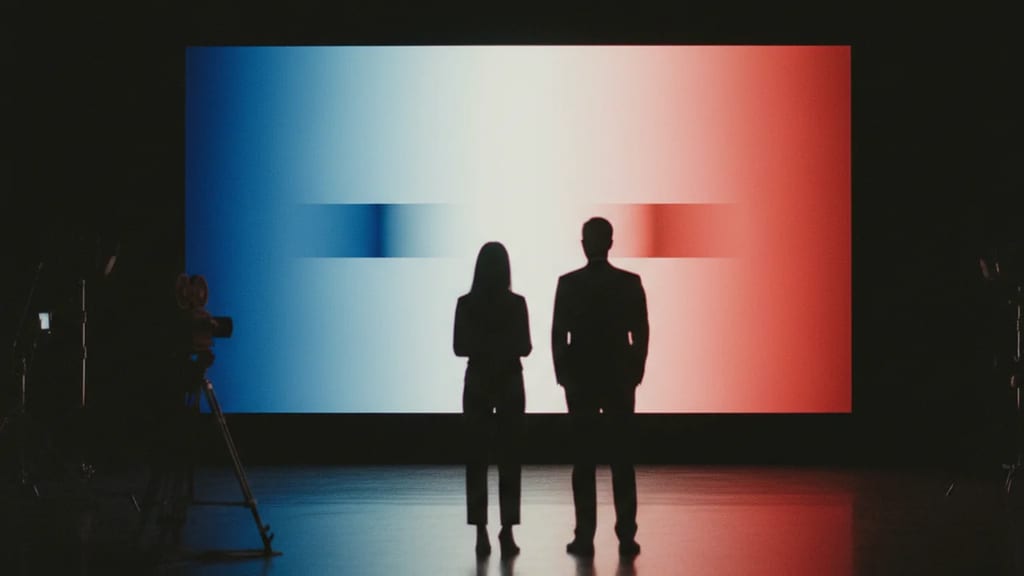
Optical illusion where the eye perceives sharp bands at soft color transitions — neuronal over-contrast processing artifact. Visible in posterization and weak gradients.
Your eye plays a trick on you with smooth color gradients: it suddenly sees dark or light bands, even though the gradient is technically uniform. This happens because your visual system overcorrects at the transition areas – neurons artificially enhance the contrast edges. On set or in the edit, this becomes a problem when you work with low bit depths or when your color depths are insufficient.
In a practical film context, you'll notice Mach banding primarily in three scenarios: Firstly, with sky gradients – especially in digital footage with an 8-bit color space, you'll suddenly see horizontal bands instead of a smooth transition from blue to white. Secondly, with minimalist image compositions featuring large, monochrome areas and smooth transitions – think of a character in front of a colored wall with subtle shading. Thirdly, it frequently occurs with posterization, meaning when color depths are lost or compressed too aggressively.
On the production side, much can be avoided: Work with 10-bit or higher if your camera and workflow allow. A slight amount of grain or dithering optically breaks up the bands – the eye then perceives the noise instead of the banding edges. In the edit and color correction, do yourself a favor: Never introduce hard color jumps into smooth gradients. When color correcting a sky or a wall, work with curves instead of hard cuts, and gently feather or blur your masks.
A practical trick from set: Use natural light or soft spotlights for transition areas – true light softness creates no sharp color edges that could later lead to the illusion. Finally, in the final mix: If your footage shows visible banding, a subtle HSL noise as a grading layer is often more economical and elegant than aggressive blur techniques. Most viewers perceive Mach banding unconsciously – it significantly disrupts the perception of your image's quality and smoothness more than you might assume.
Related terms
Quiz
1. Was beschreibt „Mach-Banding" am besten?
2. Zu welchem Department gehört „Mach-Banding"?