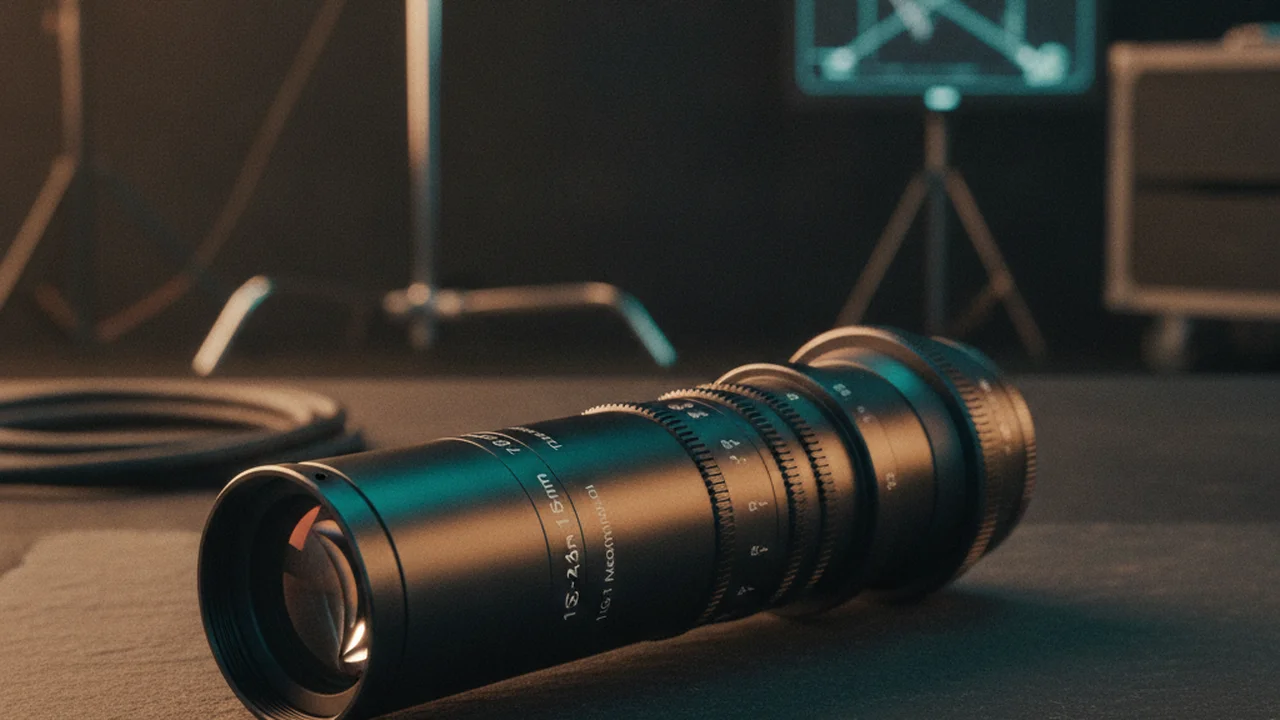
Probe lens with a zoom range: 15-24mm at a constant T8, up to 1.6:1 magnification, four probe configurations from direct view to periscope.
Venus Optics popularized the design with the Laowa 24mm Probe, which is now a staple in every tabletop rental house: a long, thin tube with an optic at the tip, waterproof, with a minimum focusing distance in the millimeter range. The Probe Zoom is the evolution, and the difference is in the name. It zooms.
The Numbers
15 to 24 millimeters at a constant T8, adjustable down to T32. Field of view between 84.1 and 110.5 degrees. Maximum magnification ratio of 1.6:1, minimum focusing distance approximately five millimeters from the front glass. The probe measures a good 54 centimeters with a front diameter of about 3.2 centimeters and is waterproof. Gears with 0.8 MOD are located on focus, aperture, and zoom. The image circle covers full frame. Available for ARRI PL, Canon EF and RF, L-Mount, Nikon Z, and Sony FE — and additionally as a bundle with the longer Probe Zoom 15-35mm T12.
Four Directions of View
The lens is available in four probe variants: direct view, 35 degrees, 90 degrees, and periscope. This is more choice than it initially seems, as the direction of view cannot be changed on set — it is determined when renting. If you don't know whether you need to look into the setup from the front or the side, you rent two.
Why the Zoom is the Real Argument
With a fixed probe, you change the framing by moving the probe. In a glass of water, a pile of powder, an engine compartment, or among the ingredients of a food setup, this means the subject is touched, and the take is ruined. The zoom range of 15 to 24 millimeters sounds narrow, but it covers precisely the range where probe shots take place. You stay put and still change the framing. That's the whole point.
What T8 Means
T8 is low light, and there's no sugarcoating it. At a magnification ratio of around 1.6:1, the depth of field has already shrunk to fractions of a millimeter anyway — a wider aperture would be practically unusable. So, the specification is by design, not a compromise. The price is in the lighting budget, and it increases further as the frame rate goes up: a probe setup at 300 frames per second requires more light than the rest of the shooting day combined, and this light must pass through the same opening as the probe itself.
Classification
The Probe Zoom stands alongside the DZOFILM X-tract, which pursues the same idea with 18-28mm at also T8, and alongside classic Snorkel and Innovision systems. Compared to the X-tract, it gains wider coverage and the choice of viewing directions; compared to the old Snorkel systems, it gains size and price. What it also doesn't solve is the fundamental problem of any probe: the image is only as good as the light that gets in at all.
Related terms
Quiz
1. Was beschreibt „Laowa Probe Zoom" am besten?
2. Zu welchem Department gehört „Laowa Probe Zoom"?