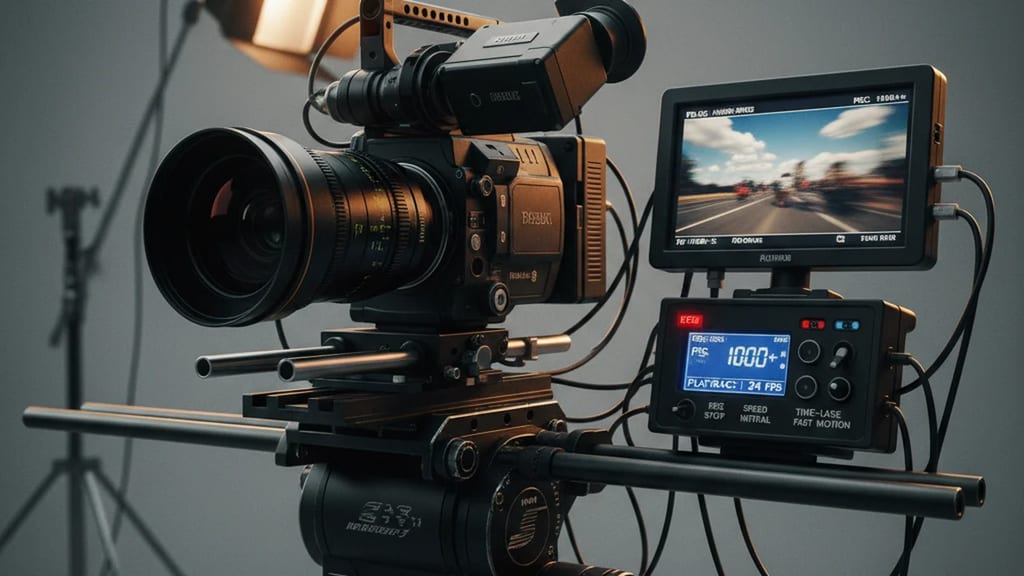
Shooting at a lower frame rate than playback — 4, 8, or 12 fps instead of 24. Motion accelerates: clouds, traffic, construction sites.
You shoot slower, the footage plays back faster — that's the core. Instead of 24 fps, you record at 4, 8, or 12 fps, but later put the reels into the normal editing rhythm. Result: movement becomes acceleration. Clouds race across the sky, a construction site grows in seconds, people appear like ants on amphetamines.
On set, it works like this: You need an absolutely stable camera — any shake will be amplified by the factor you speed up. Recording at 8 fps and playing back at 24 fps? The acceleration factor is 1:3. This also means your lighting must remain constant, otherwise your entire footage will flicker. No cloud movement without an ND filter and perfect exposure control. The classic sundial method — a long recording time over hours or days with a fixed camera — uses time-lapse as a pure long-term process.
Practically, it gets tricky with editing with real actors. If your protagonist walks up stairs and you speed up time, she appears supernaturally rushed — sometimes desired, often disruptive. Most professionals therefore use time-lapse for pure establishing shots: traffic, sky, nature, crowds from an overview. There, the effect works without psychological irritation.
Related here are slow motion (inverse logic — higher fps rate) and real-time editing, but time-lapse remains the best tool for process sequences — when you want to show how time passes without dialogue or character movements becoming a farce. Modern digital cameras do this elegantly; previously, you had to work with hand-crank cameras or mechanical intervalometers. The technology has become more accessible, but the requirement for stability and exposure has remained.
Related terms
Quiz
1. Zu welchem Department gehört „Schnelllauf"?