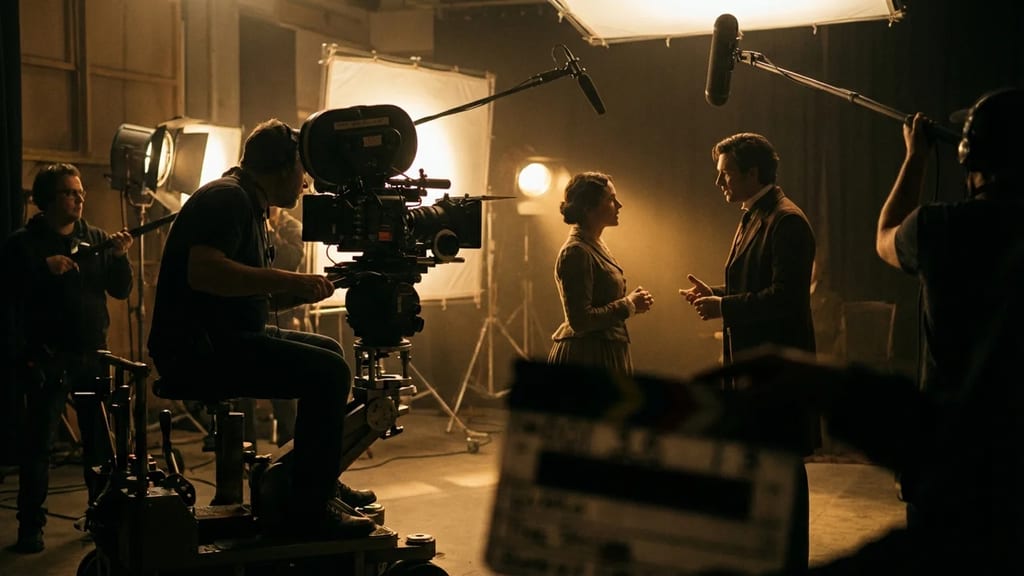
Drama
Drama is the oldest and arguably "purest" film genre—defined not by external plot action, but by internal emotional and psychological conflicts. While action films thrive on external adventures and horror on fear, drama lives by character development, interpersonal relationships, and existential questions.
The dramatic is central to all genres, but pure dramas isolate and deepen the psychological dimension without the "ornaments" of spectacle, suspense, or horror.
Definition and Core Characteristics
Character Orientation:
- The character's internal psychological state is central
- Emotional and cognitive growth or failure
- Complex, ambiguous characterization
- Authentic, realistic psychology
Levels of Conflict:
- Internal Conflict (psyche, identity, morality)
- Interpersonal Conflict (family, love, friendship)
- Societal Conflict (class, race, history)
- Existential Conflict (meaning, death, purpose)
Narrative and Plot:
- Plot follows psychological logic, not plot mechanics
- Often minimalist or everyday settings
- Frequently little "external" action
- Focus on conversation and emotional moments
Realistic Tonality:
- No fantastical or supernatural elements
- Psychological realism is standard
- Often depressive, melancholic, or ambivalent
- No sentimental resolutions guaranteed
Historical Development
Theatrical Beginnings (1900s-1920s):
Film utilized dramatic traditions of theater:
- "The Birth of a Nation" (1915) - D.W. Griffith: Controversial but formally innovative drama
- "Intolerance" (1916) - Griffith: Four parallel dramatic narratives
- "The Passion of Joan of Arc" (1928) - Carl Theodor Dreyer: Intense character study with close-ups
Expressionist Drama (1920s-1930s):
Emotional states through visual distortion:
- "The Last Laugh" (1924) - Friedrich Wilhelm Murnau: Psychological drama told without intertitles
- "Ménilmontant" (1926) - Dimitri Kirsanoff: Impressionistic female character study
Realist Drama (1940s-1950s):
Italian Neorealism and American social critique drama:
- "Rome, Open City" (1945) - Roberto Rossellini: Neorealist ensemble drama
- "The Bicycle Thief" (1948) - Vittorio De Sica: Classic Neorealist drama
- "A Streetcar Named Desire" (1951) - Elia Kazan: Tennessee Williams adaptation with Brando
- "On the Waterfront" (1954) - Kazan: Working-class drama with Method Acting
Auteur Drama (1960s-1970s):
Artistically ambitious, often formally innovative dramas:
- "Breathless" (1960) - Jean-Luc Godard: Nouvelle Vague drama about youthful alienation
- "8½" (1963) - Federico Fellini: Meta-narrative artist's drama
- "The 400 Blows" (1959) - François Truffaut: Youth drama with autobiographical intimacy
- "Andrei Rublev" (1969) - Andrei Tarkovsky: Epic, philosophical artist's drama
- "Tokyo Story" (1953) - Yasujirō Ozu: Minimalist, elegant family drama
- "Ikiru" (1952) - Akira Kurosawa: Existential drama about futility and meaning
Method Acting Drama (1950s-1960s):
Psychological depth through new acting techniques:
- Marlon Brando, Montgomery Clift, James Dean: Focus on interiority
- Intense, intellectual approach to characters
Psychological Drama (1970s-1980s):
- "Annie Hall" (1977) - Woody Allen: Neurotic comedy-drama
- "Krisha" (1979) - Andrei Konchalovsky: Soviet family drama
- "Stalker" (1979) - Tarkovsky: Quasi-drama with a science fiction frame
- "Distant" (2002) - Nuri Bilge Ceylan: Turkish minimalist drama
Contemporary/Indie Drama (1990s-Present):
- "Before" Trilogy (1995-2013) - Richard Linklater: Dialogue-heavy relationship drama
- "Mulholland Drive" (2001) - David Lynch: Psychological Hollywood drama
- "The Son" (2022) - Florian Zeller: Psychologically complex family drama
- "Minari" (2020) - Lee Isaac Chung: Immigrant family drama
- "Manchester by the Sea" (2016) - Kenneth Lonergan: Grief drama
- "Nomadland" (2020) - Chloé Zhao: Documentary-realist survival drama
- "Drive My Car" (2021) - Ryusuke Hamaguchi: Grief and performance drama
Quality Television Drama (2000s-Present):
- "The Sopranos," "The Wire," "Breaking Bad"
- Episodic structure allows for psychological depth
- Complex character development over long narratives
Visual Conventions and Film Techniques
Cinematography and Composition:
- Static or minimally-moving cameras: Observational distance
- Medium and Close-Up Shots: Focus on faces and emotional reactions
- Long Takes: Respect for the duration of emotional moments
- Eye-Level Framing: Egalitarian, non-hierarchical camera position
- Symmetrical or open composition: Psychological openness or isolation
Lighting and Tonality:
- Natural light: Respect for realistic environment
- Flat, diffused lighting: Emotional neutrality or sadness
- Practical lights: Windows, lamps as realistic sources
- Gray-brown, desaturated color palette: Melancholic or realistic tonality
- Underexposure: Psychological darkness
Editing and Rhythm:
- Longer takes with few cuts: Temporal authenticity
- Cuts align with dialogue pauses: Respect for moments of space
- Cross-cutting: Between different characters and spaces
- Fades or Dissolves: Gentle transitions between scenes
- Silence and pauses: Non-verbal communication of emotion
Sound and Music:
- Ambient sound and environmental noises: Atmospheric authenticity
- Minimal or no music: Natural-sounding environment
- Dialogue dominance: Conversations as the primary narrative method
- Diegetic music: Music from within the film's world (radio, live music)
- Voice-over as thoughts: Inner monologue for characterization
Production Design:
- Realistic, everyday settings: Apartments, houses, workplaces
- Practical furniture and decoration: Nothing stylized or exaggerated
- Historical accuracy: Costumes and accessories authentic
- Spatial arrangement as psychology: Chaos or order reflects inner states
Drama Subgenres and Variations
Family Drama:
- Intra-familial relationships as central conflict
- Generational divides and inherited trauma
- Examples: "Tokyo Story," "The Son," "Manchester by the Sea"
Romance Drama:
- Romantic or erotic relationships in crisis
- Marital conflicts, love, and betrayal
- Examples: "Brief Encounter" (1945), "Before" Trilogy, "Carol" (2015)
Coming-of-Age Drama (Bildungsroman):
- Adolescent or adult psychological development
- Coming-of-age narratives
- Examples: "The 400 Blows," Dardenne Brothers films, "Boyhood" (2014)
Working-Class/Class Drama:
- Class conflicts and economic oppression
- Working-class life and dignity
- Examples: "The Bicycle Thief," "Bread and Roses" (2000), "Parasite" (2019)
Psychological Drama:
- Mental illness or psychological breakdown
- Trauma and recovery (or failure)
- Examples: "One Flew Over the Cuckoo's Nest" (1975), "Girl, Interrupted" (1999)
Historical Drama:
- Realistic depiction of historical events and characters
- Often told through personal perspectives
- Examples: "Schindler's List" (1993), "12 Years a Slave" (2013)
Biographical Drama:
- The lives of individual historical figures
- Often focusing on pivotal moments
- Examples: "Gandhi" (1982), "The Danish Girl" (2015)
Social Issue Drama:
- Social problems and injustice
- Often documentary-style or journalistic
- Examples: "The Wire" (TV), "Spotlight" (2015)
Grief/Existential Drama:
- Death, loss, and existential emptiness
- Philosophical questions about meaning
- Examples: "Ikiru," "Manchester by the Sea," "The Last Temptation of Christ" (1988)
Narrative and Dramatic Structure
Classic Dramatic Structure (Aristotle/Freytag):
- Exposition: Introduce characters and situation
- Rising Action: Internal or external conflicts develop
- Climax: Emotional or psychological peak
- Falling Action: Consequences and resolution
- Denouement: Final emotional resolution (or ambiguity)
Modern/Non-Linear Structure:
- Fragmented chronology (flashbacks, flashforwards)
- Multiple perspectives and character focus
- Ambiguous endings
- Circular narratives
Dialogue Techniques:
- Subtext: What is unsaid is significant
- World-silence: Long pauses and moments of quiet
- Speech rhythm: Individual speech characterization
- Shouting or emotional outbursts: Rare but impactful
Themes and Existential Questions
Family and Generations:
- Parent-child relationships
- Inheritance of trauma
- Aging and transience
Love and Loneliness:
- Romantic disappointment
- Marital crisis
- Sexuality and desire
- Human connection despite isolation
Work and Dignity:
- Class conflicts and economic oppression
- Meaningfulness of labor
- Spent lives
Identity and Authenticity:
- Who am I really?
- Social masks vs. inner truth
- Migration and identity reconstruction
Death and Mortality:
- Existential dread of death
- Grief and mourning processes
- Meaning and legacy
Justice and Morality:
- Right and wrong are ambiguous
- Ethical dilemmas without clear answers
- Guilt and culpability
Technical Parameters
Film Formats:
- 35mm or Super-16mm for classic look
- Digital for indie dramas (accessibility and budget)
- 2.35:1 or 16:9 aspect ratio
Lenses:
- 50mm as a "natural" lens for intimacy
- 35mm for slightly more context
- Rarely extreme wide-angle or zoom
- Prime lenses for character
Audio:
- Crystal-clear dialogue recording
- Directional microphones for naturalism
- Minimal music or original score
- Atmos or 5.1 surround for cinema
Color Grading:
- Naturalized color grading
- Often desaturated or warm-toned
- Gentle S-curve for subtle contrasts
Drama and Audience
Dramatic film generates emotional catharsis through:
- Identification: The viewer identifies with characters
- Empathy: Understanding of the character's inner world
- Catharsis: Emotional release through tears or reflection
- Meaning: Philosophical or existential realization
Drama in Other Media
Television:
- Serial drama allows for longer character development
- "The Sopranos," "The Crown," "Succession"
Literature and Theater:
- Film adapts dramatic traditions
- Soliloquies, inner monologues, dramatic convention
Video Art and Installation:
- Video drama as an artistic medium
- Longer, contemplative works
Conclusion: Drama is the heart of the cinematic—the space where film most powerfully explores inner emotional and psychological reality. It is a genre that relies not on spectacle, but on depth of characterization, authenticity of conflict, and the profundity of human experience.
Current News
The legal drama "ZOMA," directed by Alireza Golafshan, received extensive funding from FFF, FFA, and DFFF in 2024 and is scheduled for January 2027 as a co-production with STUDIOCANAL, BR, and Arte. Concurrently, in March 2024, the FFA supported nine documentary films with over one million euros as part of its cultural film funding. These developments highlight the continued importance of drama in the German film landscape and the targeted support for fictional and documentary dramaturgy.