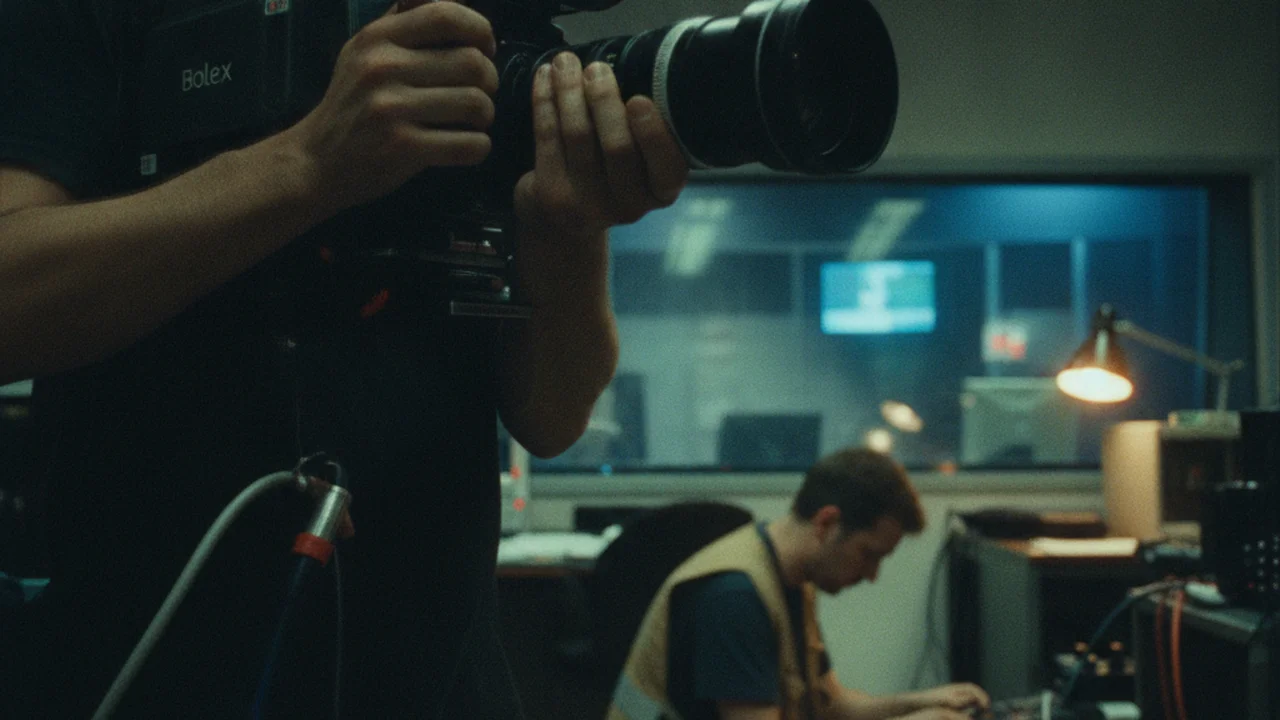
Standardised lens mount for 2/3-inch broadcast cameras (BTA S-1005, 1992). Flange depth around 48mm, with a beam-splitting prism in the camera's optical path.
B4 is the mount used for the majority of television production over the last thirty years—news, sports, studio, live. It was standardized in 1992 as BTA S-1005 and has remained virtually unchanged since. Anyone who has held an ENG camera has held a B4 mount.
What Distinguishes It from Cinema Mounts
The crucial difference lies not in the mount itself, but behind it. A 2/3-inch broadcast camera has three sensors, and between the lens and the sensors sits a prism that splits the light into red, green, and blue. This prism is glass in the light path, and glass in the light path requires a lens to be calculated for it. Therefore, a B4 lens does not function meaningfully on a camera without a prism, and this is why the flange focal distance is an unusually large approximately 48mm for such a small image circle.
The Image Circle
In practice, 2/3 inch means an 11mm image diagonal, or 8.8 x 6.6mm in a 4:3 aspect ratio. This is significantly smaller than Super 16 and a fraction of Super 35. The consequence is the characteristic for which B4 zooms are known: zoom ranges that are unavailable in any other format. A twenty-times zoom with consistently usable aperture is buildable for this image circle, but not for Super 35.
What's Written on the Lens
The nomenclature of broadcast manufacturers is dense but readable. With Fujinon, a missing prefix indicates Standard Definition, while HA or HS denotes HD. This is followed by the format, the zoom ratio, the shortest focal length, then letters for mount, extender, and drive type: B for Bayonet, E for built-in extender, R for zoom servo, M for manual focus. An A20x8.6BRM is therefore a 2/3-inch SD twenty-times zoom starting at 8.6mm with a bayonet mount, no extender, motorized zoom, and manual focus.
Adaptation
Operating B4 lenses on cameras with a single sensor is possible, but always a compromise. There are adapters with built-in optics that stretch the small image circle to Super 16 or MFT, and they cost light and sharpness. The reverse is not possible: adapting a PL lens to a B4 camera fails due to the flange focal distance and the prism. Those who want the broadcast look should use the broadcast camera.
Related terms
Quiz
1. Was beschreibt „B4-Bajonett" am besten?
2. Zu welchem Department gehört „B4-Bajonett"?