Director
The creative or operational relevance to directing
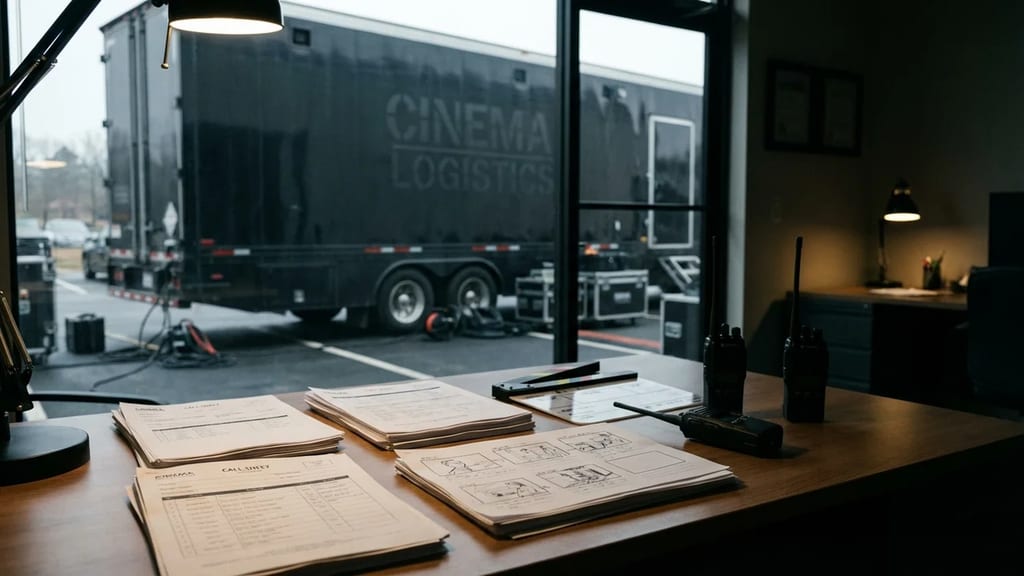
Semi-trailer approximately 48 feet long — the largest common transport unit on set, used for equipment, art department supplies, or fitted out as a working vehicle.
The 48-foot trailer is the large semi-trailer specified as 48 feet in US productions. It comes as a pure transport vehicle or as a fitted-out work trailer — with shelves, power, air conditioning, and workstations.
It requires space, and not just for parking: turning radius, approach height, ground load capacity. A location in an old town with a semi-trailer in the schedule is a contradiction that becomes apparent on the shooting day. The location department therefore checks the access beforehand — with a measuring tape, not on a map.
The creative or operational relevance to directing
When we talk about a "lens package," we're not just talking about a bunch of lenses. It's the entire set of optics we've chosen for a specific film, and it's a crucial decision that impacts everything from the look of the movie to how we shoot it. For me, as a producer, it's about balancing creative vision with practical realities. We need to make sure the lenses we select can achieve the specific aesthetic the director wants, whether that's wide and immersive with a 14mm or intimate and compressed with an 85mm. But it's also about budget, availability, and how they perform on set. For instance, if we're shooting a lot of handheld or Steadicam work, we'll prioritize lighter, faster lenses, maybe primes in the 24mm to 50mm range. If it's a more controlled shoot with a dolly or crane, we might opt for heavier zooms or specialized lenses like an anamorphic set. We also consider the T-stops – a T2.2 is very different from a T1.5 when it comes to low light performance, and that can dictate our lighting package and how much time we have on set. The lens package is a foundational element of the production design and cinematography, and getting it right from the start saves us a lot of headaches down the line.
1. Was beschreibt „15-Meter-Trailer" am besten?
2. Zu welchem Department gehört „15-Meter-Trailer"?
3. Wie viele verschiedene Fachperspektiven bietet dieser Eintrag?
The Lexikon is part of the Filmfarm ecosystem — alongside budgeting (FilmBalance), an industry magazine (FilmCircus) and crew networking (FilmCall, CrewMesh). One shared vocabulary for the whole production.