Cinematographer
1.66:1 gives us more side room than Academy standards, but remains more moderate than Cinemascope. It's ideal for subtle, realistic lighting design.
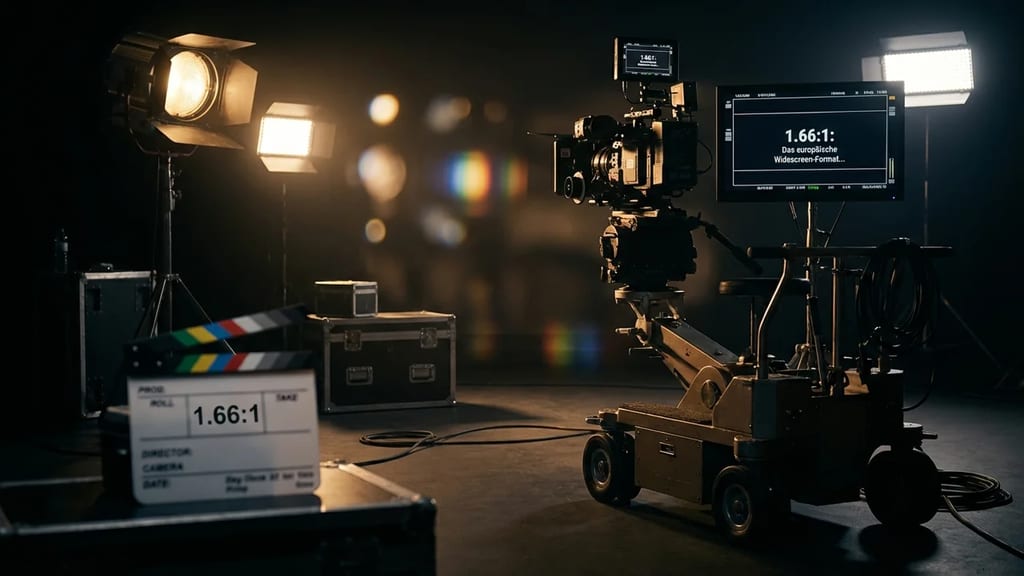
European widescreen format 1.66:1, standard for European cinemas from the 1960s. A compromise between the square Academy standard (1.33:1) and extreme Cinemascope (2.35:1), preferred in Europe, India, and other regions.
Fellini's masterpiece was shot in 1.66:1, demonstrating how the European widescreen ratio provides enough room for surreal dream sequences while preserving the intimacy of the frame.
Wenders and Alekan used the 1.66:1 ratio to capture divided Berlin in a frame that feels neither too tight nor too panoramic – a characteristically European middle ground.
Haneke and Berger employed the 1.66:1 ratio to merge the claustrophobic intimacy of chamber drama with the horizontal tension of widescreen – a paradox made possible by the European format.
Maren Ade's award-winning film was shot in 1.66:1, demonstrating that this European standard remains vital in contemporary art cinema, creating space for nuanced character relationships.
The 1.66:1 format was established as the European standard from the late 1950s / early 1960s. It was a reaction to the widescreen revolution (Cinemascope from 1953), but with European restraint.
Development Context:
Why 1.66:1 in Europe?
Aspect Ratio Specifications:
Realization:
Projector Standard:
The 1.66:1 format has been largely replaced by 1.85:1 and 2.35:1 in modern cinema, but is still used:
Regional Usage:
Current Productions:
Why the Replacement:
| Standard | Ratio | Region | Cinema Era | Characteristics |
|---|---|---|---|---|
| 1.33:1 | Academy | USA/Global | 1932-1980 | Classic, square |
| 1.66:1 | European | Europe | 1960-1995 | Balanced, artistic |
| 1.85:1 | American | USA/Global | 1970-Present | Modern Standard |
| 2.35:1 | Cinemascope | Epic/Global | 1953-Present | Extreme Widescreen |
| 2.20:1 | Panavision | Alternative | 1970-Present | Premium Widescreen |
Technical Differences:
| Aspect | 1.66:1 | 1.85:1 | 2.35:1 |
|---|---|---|---|
| Height to Width | 60% | 54% | 43% |
| Film Usage | Full 35mm | Full 35mm | Anamorphic/VistaVision |
| Projection | Spherical | Spherical | Anamorphic De-squeeze |
| Light Efficiency | Higher | Medium | Lower (Anamorphic) |
| Trend Direction | Decreasing | Decreasing | Increasing |
Famous Films in 1.66:1:
(Note: Many of these films were later re-released in different ratios)
For Filmmakers:
For Viewers:
Modern digital productions aiming to simulate 1.66:1:
Standards and Documentation:
Related Entries:
1.66:1 gives us more side room than Academy standards, but remains more moderate than Cinemascope. It's ideal for subtle, realistic lighting design.
1.66:1 is a European philosophy: it preserves intimacy while allowing more width for visual storytelling. Popular in art-house cinema and psychological dramas.
1. Was beschreibt „Europäisches Breitbildformat / 1.66:1" am besten?
2. Zu welchem Department gehört „Europäisches Breitbildformat / 1.66:1"?
3. Wie viele verschiedene Fachperspektiven bietet dieser Eintrag?
The Lexikon is part of the Filmfarm ecosystem — alongside budgeting (FilmBalance), an industry magazine (FilmCircus) and crew networking (FilmCall, CrewMesh). One shared vocabulary for the whole production.